

Development-Lifecycle-and-Deployment-Designer Pre-Exam Practice Tests | (Updated 226 Questions)
Valid Development-Lifecycle-and-Deployment-Designer Exam Q&A PDF - One Year Free Update
NEW QUESTION 51
The release will be deployed over a weekend, one week after Salesforce updates the production environment (e.g., from Winter to Spring). UC has found that a full sandbox refresh can take several days. What should the architect suggest as an optimal deployment plan?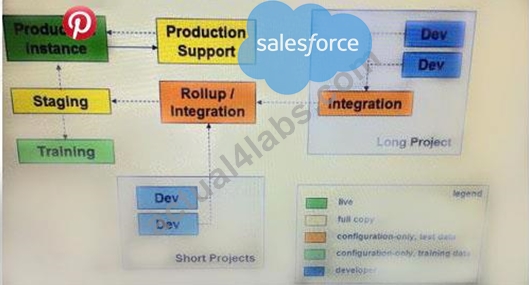
- A. One week before go -live, initiate the Staging sandbox refresh and then immediately deploy to Staging.
Deploy from Staging to Production at go-live - B. Two weeks before go -live, deploy to Staging and then refresh the Staging and Production support sandboxes. Deploy from Staging to Production at go-live
- C. Approximately six weeks before go -live, ensure the sandbox will be on the release preview. One week before go live, deploy to Staging. Deploy from Staging to Production at go-live
- D. One month before go -live, deploy to Staging and to Production Support. Deploy from Production Support to Production at go-live
Answer: C
NEW QUESTION 52
Universal Containers (UC) is implementing Service Cloud for their contact centers for 3000 users. They have
~10 million customers. The average speed response time expected is less than 5 seconds with 1,500 concurrent users. What type of testing will help UC measure the page response time?
- A. Unit Testing.
- B. Stress Testing.
- C. System Integration Testing.
- D. Load testing.
Answer: D
NEW QUESTION 53
At any given time, Universal Containers has 10 Apex developers building new functionality and fixing bugs.
Which branching strategy should an Architect recommend that mitigates the risk of developers overwriting others changes?
- A. Don't use source control. Rely on Salesforce's built-in conflict detection mechanism
- B. Have all developers build new functionality in new branches, but fix bugs in the HEAD
- C. Have developers work in separate branches and merge their changes in a common branch for testing
- D. Have all developers work in the same branch, continuously testing for regressions
Answer: C
NEW QUESTION 54
Which two groups are responsible for the creation and execution of Release Management processes? Choose 2 answers
- A. Center of Excellence
- B. End Users
- C. Steering Committee
- D. Dev/Build Team
Answer: A,D
NEW QUESTION 55
Which two ways should a developer working on a data loading integration that operates between different Salesforce environments insert multiple related records in one call or transaction?
Choose 2 answers
- A. Streaming API
- B. REST API SObject Tree Request
- C. Bulk API 2.0
- D. REST API Composite Request
Answer: B,D
NEW QUESTION 56
Universal Containers (UC) operates from North America and does business within North America. UC has just acquired a local company in Asia to start operating from Asia.
Currently, these two business units operate in two different languages. Both units have different sales processes and have to comply strictly with local laws. During the expansion phase, UC would like to focus on innovation over standardization.
What should an Architect recommend given the scenario?
- A. Opt for Multi-org strategy, each org has its own sales process, common rules, and operate in locale.
- B. Opt for Single-org strategy, standardized sales process, common rules, and business unit-specific locale.
- C. Opt for Multi-org.strategy, standardized sales process, common rules, and same locale across orgs.
- D. Opt for Single-org strategy, standardized sales process, common rules, and same locale for all business units.
Answer: A
NEW QUESTION 57
Universal Containers is considering developing a client application using the Metadata API for managing deployments to multiple Salesforce orgs. Which two use cases describe the usage of Metadata API? Choose 2 ans
- A. Export current customization in the organization as an xml file.
- B. Migrate data changes between two organizations using a csv file.
- C. Perform CRUD operations o manage records in the organization.
- D. Migrate configuration changes between two organizations.
Answer: A,D
NEW QUESTION 58
Universal Containers CUC) is working with Salesforce CPQ, which uses configuration SObjects to drive business logic.
What are two best practice recommendations an architect should propose to allow UC to deploy CPQ features as part of their CI/CD process?
Choose 2 answers
- A. Use an open source SFDX plugin and version control.
- B. Use data loader to deploy CSV files.
- C. Build an Apex framework to deploy CPQ records.
- D. Use a third-party product.
Answer: C,D
NEW QUESTION 59
A Salesforce partner intends to build a commercially available application by creating a managed package for distribution through AppExchange.
What two types of environments can the partner use for development of the managed package? Choose 2 answers
- A. Developer sandbox
- B. Partner Developer Edition
- C. DeveloperEdition
- D. Developer Pro sandbox
Answer: A,B
NEW QUESTION 60
Universal Containers wants to implement a release strategy with major releases every four weeks and minor releases every week. Major releases follow Development, System Testing (SIT), User Acceptance Testing (UAT) and Training Minor releases follow Development and User Acceptance Testing (UAT) stages. What represents a valid environment strategy consideration for UAT?
- A. Minor releases use Developer and Major releases Full copy
- B. Minor and Major releases use separate Developer pro
- C. Minor and Major releases use same Full copy.
- D. Minor releases use Partial copy and Major releases use Full copy
Answer: D
NEW QUESTION 61
Universal Containers is replacing an old legacy system with Salesforce.
Which two strategies should the plan consider to mitigate the risks associated with migrating data from the legacy system to Salesforce? (Choose two.)
- A. Identify the data relevant to the new system, including dependencies, and develop a plan/scripts for verification of data integrity.
- B. Migrate users in phases based on their function, requiring parallel use of legacy system and Salesforce for certain period of time.
- C. Use a full sandbox environment for all the systems involved, a full deployment plan with test data generation scripts, and full testing including integrations.
- D. Use a full sandbox environment and perform test runs of data migration scripts/processes with real data from the legacy system.
Answer: B,D
NEW QUESTION 62
Universal Containers (UC) is implementing a governance framework and has asked the Architect to make recommendations regarding release planning. Which two decisions should the Architect make when planning for releases? Choose 2 answers
- A. Whether Salesforce will wait to upgrade the pod until after a UC release is complete.
- B. How to test existing functionality to ensure no regressions are introduced.
- C. How to roll back to the previous Salesforce release if there are issues.
- D. When to test a new UC feature release if there are issues.
Answer: C
NEW QUESTION 63
Universal Containers (UC) is preparing for the new Salesforce release in a couple of months, and has several ongoing development projects that may be affected. Which three steps should the team at UC take to prepare for this release? Choose 3 answers
- A. Refresh a Sandbox during the Release Preview Window to ensure they have the upcoming release.
- B. Contact Salesforce to schedule a time to upgrade the full Sandbox.
- C. Upgrade any SOAP integrations to the newest WSDL as early as possible
- D. Review the release notes for automatically-enabled features and technical debt.
- E. Run regression tests in an upgraded sandbox to detect any issues with the Upgrade.
Answer: A,D,E
NEW QUESTION 64
A team has completed a sprint and intends to deploy these changes after business approval, but they will immediately begin the next sprint.
What strategy should an architect recommend?
- A. Using Git, create a release branch from the develop branch. All fixes must be made in the release branch.
After deployment, merge release with develop. - B. Commit upcoming changes to the features branch without merging into the develop branch. Deploy from the develop branch and then merge new sprint features into the develop branch.
- C. Migrate the current code to the UAT sandbox. Begin new sprint development in the Dev sandbox. Make fixes in the UAT environment and deploy UAT for production after business approval
- D. The first task of the new sprint must be the deployment approval. After that, the other tasks of the sprint can be performed in the environments and Git
Answer: C
NEW QUESTION 65
Universal Containers has just initiated a project to implement a custom container tracking application with a large development team. The project manager is concerned that the large number of developers in a single developer pro sandbox could lead to challenges with code being overwritten. Which two methods should be used to mitigate this risk? Choose 2 answers
- A. Use a single sandbox and strictly coordinate development across shared components, and implement a code repository to allow developers to merge code into a common repository (Missed)
- B. Replace the developer pro sandbox with a Partial copy sandbox
- C. Provide each developer their own sandbox developer org and implement a code repository and continuous integration to merge code into the developer pro sandbox (Missed)
- D. Provide each developer their own sandbox developer org, and implement managed packages to deploy to the merge
Answer: A,C
NEW QUESTION 66
There has been an increase in the number of defects .Universal Containers (UC) found the root cause to be decreased in quality if code. Which two options can enforce code quality in UC's continuous integration process? Choose 2 answers
- A. Introduce manual code review before deployment to the testing sandbox.
- B. Introduce manual code review before deployment to the production org.
- C. Increase the size of the testing team assigned to the project.
- D. Introduce static code analysis before deployment to the testing sandbox.
Answer: A,D
NEW QUESTION 67
A team has completed a sprint and intends to deploy these changes after business approval, but they will immediately begin the next sprint.
What strategy should an architect recommend?
- A. Migrate the current code to the UAT sandbox. Begin new sprint development in the Dev sandbox. Make fixes in the UAT environment and deploy UAT for production after business approval.
- B. Commit upcoming changes to the features branch without merging into the develop branch. Deploy from the develop branch and then merge new sprint features into the develop branch.
- C. Using Git, create a release branch from the develop branch. All fixes must be made in the release branch. After deployment, merge release with develop.
- D. The first task of the new sprint must be the deployment approval. After that, the other tasks of the sprint can be performed in the environments and Git.
Answer: C
NEW QUESTION 68
Universal containers is looking to install a new application to enable advanced quoting in its current Professional Edition org. The org is near capacity with object and tab limits. Which two solutions should the Architect recommend? Choose 2 answers
- A. Upgrade to an Enterprise Edition org
- B. Install an Aloha certified App
- C. Create and install an unmanaged package
- D. Buy more user licenses to increase org limits
Answer: A,D
NEW QUESTION 69
Universal Containers (UC) is working on a major project release and is using the environments depicted in the following diagram.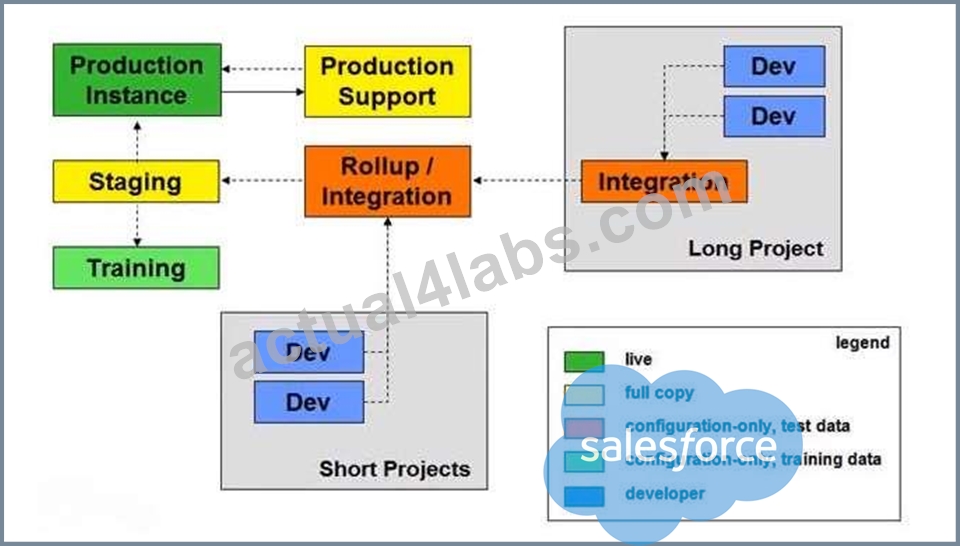
The release will be deployed over a weekend, one week after Salesforce updates the production environment (e.g., from Winter to Spring). UC has found that a full sandbox refresh can take several days.
What should the Architect suggest as an optimal deployment plan?
- A. One week before go-live, initiate the Staging sandbox refresh and then immediately deploy to Staging.
Deploy from Staging to Production at go-live. - B. One month before go-live, deploy to Staging and to Production Support. Deploy from Production Support to Production at go-live.
- C. Approximately six weeks before go-live, ensure the sandbox will be on the release preview. One week before go live, deploy to Staging. Deploy from Staging to Production at go-live.
- D. Two weeks before go-live, deploy to Staging and then refresh the Staging and Production support sandboxes. Deploy from Staging to Production at go-live.
Answer: C
NEW QUESTION 70
......
Salesforce Certified Development Lifecycle and Deployment Designer Free Update Certification Sample Questions: https://gocertify.actual4labs.com/Salesforce/Development-Lifecycle-and-Deployment-Designer-actual-exam-dumps.html